
Vastu Shastra - வாஸ்து சாஸ்திரம்
Complete Guide to 8 Directions & Manaiyadi Shastram
Vastu Shastra (वास्तु शास्त्र) is the ancient Indian science of architecture and spatial design that harmonizes human dwellings with natural cosmic energies. It is the traditional Hindu system for designing buildings to promote health, wealth, prosperity, and spiritual well-being.
Introduction to Vastu Shastra
Origins and Purpose
Vastu Shastra is believed to have originated from the ancient Vedic texts, particularly the Sthapatya Veda (the Veda of architecture), which is part of the Atharva Veda.
Core Principles:
-
Panchamahabhuta (पञ्चमहाभूत) - Five Great Elements
- Prithvi (पृथ्वी) - Earth
- Jala (जल) - Water
- Agni (अग्नि) - Fire
- Vayu (वायु) - Air
- Akasha (आकाश) - Space/Ether
-
Directional Energies - Each direction has specific cosmic energies
-
Vastu Purusha Mandala - Sacred geometric diagram representing the cosmic being in a building
-
Harmony with Nature - Aligning structures with natural forces (sun, wind, magnetic fields)
Purpose:
- Maximize positive energy flow
- Minimize negative influences
- Create balance and harmony
- Promote health, wealth, and prosperity
- Enhance spiritual growth
Vastu Purusha Mandala - वास्तु पुरुष मण्डल
The Sacred Geometric Foundation of Vastu
The Vastu Purusha Mandala (वास्तु पुरुष मण्डल) is the fundamental metaphysical blueprint and sacred diagram upon which all Vastu Shastra principles are based. It represents the cosmic energy pattern that underlies every building and plot of land.
Etymology:
- वास्तु (Vāstu) = Dwelling, site, building
- पुरुष (Puruṣa) = Cosmic being, divine person, universal soul
- मण्डल (Maṇḍala) = Circle, sacred diagram, geometric pattern
Complete Meaning: “The Sacred Geometric Diagram of the Cosmic Dwelling Being”
The Legend of Vastu Purusha
The Mythological Origin:
According to ancient Hindu texts, particularly the Matsya Purana and Brihat Samhita, the Vastu Purusha came into being during a cosmic battle between the gods and a formless, chaotic being.
The Story:
Long ago, a powerful demon in the form of a shapeless, dark entity emerged from the sweat of Lord Brahma (or according to some versions, from Lord Shiva’s cosmic dance). This being grew so powerful and consumed so much energy that it began to block the light of the sun and threatened to envelope the entire cosmos in darkness.
Terrified, the gods approached Lord Brahma for help. The gods, including Brahma, Vishnu, Shiva, and the 45 deities (collectively making 45 deities in some versions, or up to 81 deities in others), together overpowered this chaotic being and forced it face-down onto the earth.
The Cosmic Being Becomes the Foundation:
As the 45 deities held down this being, it cried out to Lord Brahma: “Why am I being punished? What is my fault? Give me a purpose!”
Lord Brahma took pity and blessed the being:
“From this day forth, you shall be known as Vastu Purusha - the Spirit of the Dwelling. You shall reside in every plot of land and every building. All who construct buildings must worship you and honor your body. Those who respect you shall prosper with peace, health, and wealth. Those who disrespect or harm you shall face difficulties and obstacles.”
The Mandala Formation:
The gods then positioned themselves on different parts of Vastu Purusha’s body, each deity occupying a specific zone. This created the Vastu Purusha Mandala - a sacred grid where:
- The Vastu Purusha lies face-down, head in the Northeast, feet in the Southwest
- 45 deities (or 81 in detailed versions) occupy specific positions on his body
- Each position corresponds to a direction and function in a building
Structure of Vastu Purusha Mandala
The Grid System:
The Vastu Purusha Mandala is typically represented as a square grid divided into smaller squares. The most common versions are:
- Manduka Mandala (Manduka = Frog) - 8×8 grid (64 squares)
- Paramashayika Mandala - 9×9 grid (81 squares) - Most detailed and commonly used
- Pithapada Mandala - 4×4 grid (16 squares) - Simplified version
The 9×9 Grid (81 Squares):
This is divided into zones with specific purposes:
| Zone | Sanskrit Name | Number of Squares | Significance | Usage |
|---|---|---|---|---|
| Inner Core | ब्रह्मस्थान (Brahmasthan) | 9 squares (center 3×3) | Sacred center, Brahma’s abode | Must remain empty/open |
| Inner Ring | देवस्थान (Devasthan) | Around Brahmasthan | Deity positions | Important rooms |
| Outer Ring | मानुषस्थान (Manushthan) | Next layer | Human habitation | Living spaces |
| Peripheral | पैशाचस्थान (Paisachatshan) | Outer edges | Negative energies | Service areas, toilets |
Body Position of Vastu Purusha
Orientation on the Plot:
The Vastu Purusha lies face-down (prone position) on every plot with:
| Body Part | Direction | Deity Governing | Significance | Effect of Damage |
|---|---|---|---|---|
| Head | Northeast | Īśāna (Shiva) | Consciousness, spirituality, wisdom | Mental problems, spiritual blocks |
| Face | East | Indra, Surya | Vision, clarity, awareness | Confusion, lack of direction |
| Chest/Heart | Center (Brahmasthan) | Brahma | Life force, soul | Critical health issues |
| Right Arm | East-Southeast | Parjanya, Jayanta | Strength, action | Weakness in execution |
| Left Arm | North-Northeast | Soma, Bhallata | Wealth acquisition | Financial problems |
| Stomach | Center-South | Aryaman, Vivasvan | Digestion, processing | Health issues |
| Hips/Navel | Southwest-Center | Pitru, Mahisha | Stability, foundation | Instability, anxiety |
| Legs | West-Southwest | Varuna, Mriga | Support, movement | Lack of support |
| Feet | Southwest | Nirriti, Pitru | Grounding, ancestors | Ancestral problems |
Key Anatomical Principles:
-
Head (Northeast) = Most sensitive and sacred
- Must be kept light, open, clean, elevated (spiritually)
- Water bodies here are auspicious
- Defects here affect mental and spiritual health
-
Heart (Center - Brahmasthan) = Life force center
- Must remain empty and open
- No pillars, staircases, or heavy structures
- Represents the soul of the building
-
Feet (Southwest) = Foundation and stability
- Must be heavy and elevated (physically)
- Provides grounding and ancestral connection
- Defects here cause instability and insecurity
The 45 Deities of Vastu Purusha Mandala
Primary Deities and Their Positions:
While there are different versions with different numbers of deities (32, 45, or 81), the 45-deity system is most commonly referenced:
Northeast Quadrant (Head Region):
- Īśāna (ईशान) - Northeast corner - Lord Shiva, supreme deity
- Parjanya (पर्जन्य) - Rain god
- Jayanta (जयन्त) - Indra’s son
- Surya (सूर्य) - Sun god - East
- Satya (सत्य) - Truth deity
Southeast Quadrant (Right Side):
- Agni (अग्नि) - Southeast corner - Fire god
- Pusha (पूषा) - Nourishment deity
- Vitatha (वितथ) - Deity of falsehood (to be overcome)
- Grihakshata (गृहक्षत) - House protector
Southwest Quadrant (Feet/Lower Region):
- Nirriti/Nairritya (निऋति) - Southwest corner - Goddess of misery (when disrespected)
- Pitru (पितृ) - Ancestors
- Dauvarika (दौवारिक) - Doorkeeper
- Sugrīva (सुग्रीव) - Monkey king
- Mahisha (मः) - Buffalo demon
Northwest Quadrant (Left Side):
- Vayu (वायु) - Northwest corner - Wind god
- Varuna (वरुण) - West - Water god
- Asura (असुर) - Demon (negative to be controlled)
- Shosha (शोष) - Drying/draining energy
Central Region:
- Brahma (ब्रह्मा) - Creator god - Center of Mandala
- Aryaman (अर्यमन) - Nobility deity
- Vivasvan (विवस्वान्) - Another form of Sun
- Mitra (मित्र) - Friendship deity
- Prithvidhara (पृथ्वीधर) - Earth supporter
North Zone:
- Kubera (कुबेर) - North - Wealth god
- Soma (सोम) - Moon god
- Mukhya (मुख्य) - Chief deity
And approximately 19 more minor deities occupying the remaining positions around the grid.
Significance & Application of Vastu Purusha Mandala
1. Architectural Planning:
Every building should be designed as if it’s the body of Vastu Purusha:
-
Respecting the Head (Northeast): Keep it clean, light, open, and sacred
- Prayer rooms, water sources, open spaces
- No toilets, kitchens, or heavy storage
-
Strengthening the Feet (Southwest): Make it heavy, elevated, and stable
- Master bedroom, heavy storage, overhead tanks
- Maximum weight and height
-
Protecting the Heart (Brahmasthan/Center): Keep it empty and free
- Open courtyard, living area, or just empty space
- No pillars, walls, or staircases
-
Activating the Limbs: Each direction serves its deity’s purpose
- Southeast (right arm/Agni): Kitchen and fire activities
- Northwest (left side/Vayu): Movement, guests, temporary spaces
2. Energy Flow:
The Vastu Purusha Mandala creates a map of energy flow:
- Positive energy enters from Northeast (head) - divine consciousness
- Flows through the Brahmasthan (heart) - central distribution
- Negative energy exits from Southwest (feet) - grounding into earth
- Balanced circulation through all eight directions
3. Spiritual Connection:
- The building becomes a living entity, not just a structure
- Worshipping Vastu Purusha before construction brings blessings
- Respecting the mandala aligns the building with cosmic order
- Inhabitants live in harmony with universal energies
Vastu Purusha Puja - वास्तु पुरुष पूजा
Before beginning construction, it’s traditional to perform Vastu Puja to worship Vastu Purusha and seek permission.
Vastu Purusha Mantra:
ॐ वास्तोष्पते प्रति जानीह्यस्मान्स्वावेशो अनमीवो भवोऽनः ।यत् त्वे महे प्रति तन्नो जुषस्वशं नो भव द्विपदे शं चतुष्पदे ॥
Om Vāstoṣpate prati jānīhyasmānSvāveśo anamīvo bhavo'naḥ |Yat tve mahe prati tanno juṣasvaŚaṃ no bhava dvipade śaṃ catuṣpade ||Translation: “O Lord of the Dwelling (Vastu Purusha), recognize us and be pleased with us. Bless our entrance, be without disease for us. Whatever we offer to you with devotion, accept it favorably. Bless us with peace for both humans (two-legged) and animals (four-legged).”
When to Perform:
- Before starting construction (Bhoomi Puja)
- Before moving into a new home (Griha Pravesh)
- During Vastu Shanti (Vastu pacification ceremony)
- On auspicious days when correcting Vastu defects
Brahmasthan - The Sacred Center
ब्रह्मस्थान (Brahmasthan) = The dwelling place of Brahma, the cosmic creator
Location: The center 9 squares (3×3 grid) in the middle of any plot or building
Significance:
- Heart of Vastu Purusha: This is where Brahma sits on the heart/navel of Vastu Purusha
- Energy Vortex: All cosmic energy flows through this central point
- Soul of the Building: Represents the life force and consciousness
- Balance Point: Distributes energy to all eight directions equally
Brahmasthan Rules:
✅ Ideal Uses:
- Open courtyard (முற்றம் - Mutram in Tamil homes)
- Living room with high ceiling
- Prayer area (if kept open and clean)
- Open-to-sky space
- Light well in multi-story buildings
❌ Strictly Avoid:
- Toilets or bathrooms (extremely inauspicious)
- Kitchen (causes health problems)
- Staircases (blocks energy flow)
- Heavy pillars or walls (obstructs center)
- Store rooms or clutter
- Underground septic tanks
- Sleeping directly on Brahmasthan
Effects of Brahmasthan Defects:
Blocked or defective Brahmasthan causes:
- Chronic health problems (especially heart, lungs)
- Financial instability
- Mental stress and depression
- Lack of peace in family
- Obstacles in all endeavors
Remedies:
- Keep the center as open as possible
- If stairs exist, keep them well-lit and clean
- Place a Vastu Yantra in the center
- Install skylight if possible
- Use light colors
- Regular cleaning and energy clearing
Practical Application: Plot Division
How to Apply Vastu Purusha Mandala to Your Plot:
- Draw the Plot: Create an accurate scaled drawing of your plot
- Make it Square/Rectangular: If irregular, work with the largest square/rectangle
- Divide into Grid: Create a 9×9 grid (81 equal squares)
- Identify Brahmasthan: Mark the center 9 squares (3×3)
- Mark Directions: Identify all 8 directions accurately using a compass
- Plan Rooms: Allocate rooms according to directional deity functions
Example for a 30’ × 30’ Plot:
- Divide into 9 rows and 9 columns
- Each square = approximately 3.33’ × 3.33’
- Center 3×3 (9 squares) = 10’ × 10’ Brahmasthan
- Keep this area open or as living room
- Northeast 3×3 = Puja room
- Southwest 3×3 = Master bedroom
- Southeast section = Kitchen
Vastu Purusha Mandala: Key Takeaways
The Living Building Concept:
When you understand Vastu Purusha Mandala, you realize:
- Your building is alive - It has a head, heart, limbs, and feet
- Every direction has consciousness - Governed by specific deities
- Respect brings blessings - Honoring Vastu Purusha brings prosperity
- Defects cause suffering - Like hurting parts of a body causes pain
- Remedies are healing - Vastu corrections heal the building’s energy
The Sacred Relationship:
- Northeast (Head): Light, wisdom, spirituality → Keep open and sacred
- Center (Heart): Life force, balance → Keep empty and flowing
- Southwest (Feet): Stability, ancestors → Keep heavy and honored
- All Directions: Each deity’s energy → Respect and utilize properly
The 8 Directions - अष्ट दिशा (Ashta Disha)
Complete Directional System
The 8 directions form the foundation of Vastu Shastra. Each direction is governed by a deity, associated with an element, and has specific energies and characteristics.
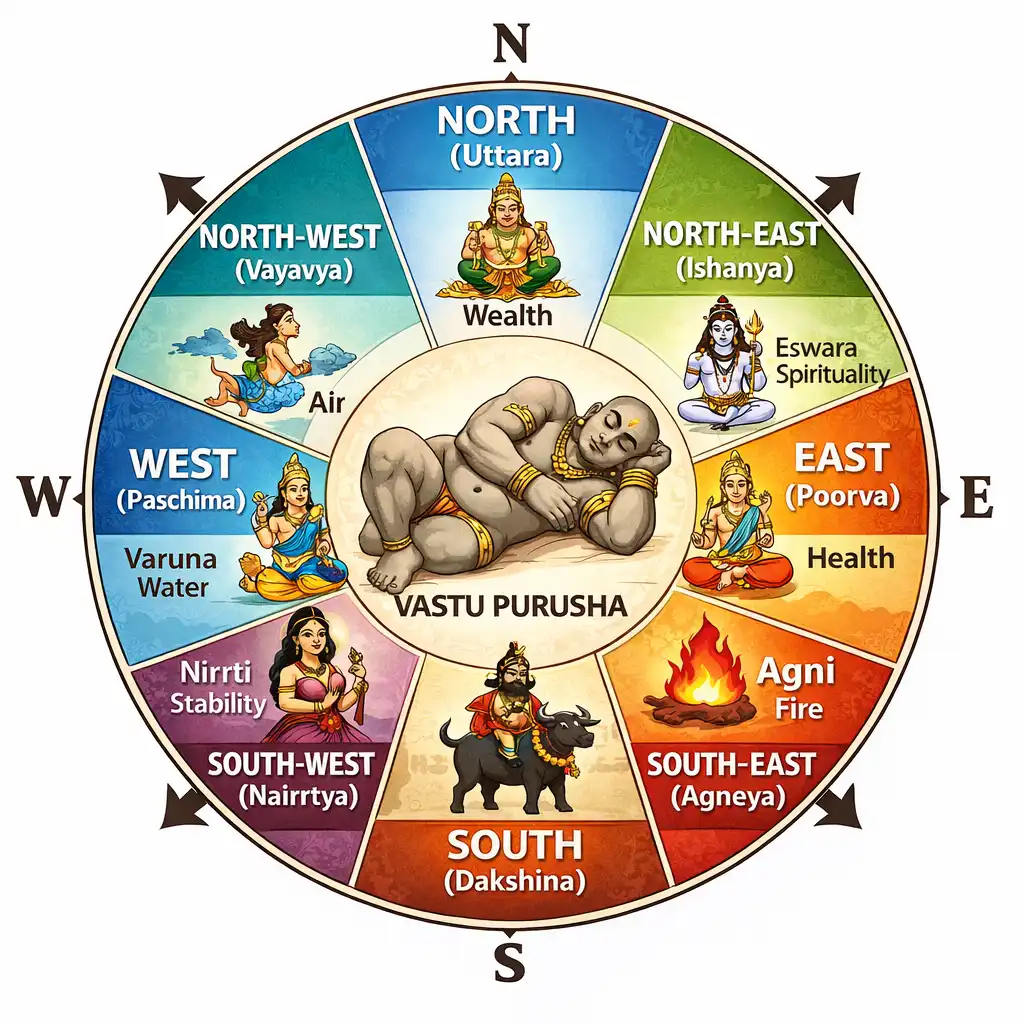
| Direction | Sanskrit | Tamil | Deity | Element | Energy/Quality | Color | Significance |
|---|---|---|---|---|---|---|---|
| East | पूर्व (Pūrva) | கிழக்கு (Kizhakku) | Indra (इन्द्र) | Air + Fire | New beginnings, growth, vitality | White, Light Blue | Sunrise, health, knowledge |
| Southeast | आग्नेय (Āgneya) | தென்கிழக்கு (Thenkirakku) | Agni (अग्नि) | Fire | Energy, passion, metabolism | Red, Orange, Pink | Kitchen, fire element |
| South | दक्षिण (Dakṣiṇa) | தெற்கு (Therku) | Yama (यम) | Fire | Longevity, death, discipline | Red, Maroon | Fame, recognition |
| Southwest | नैऋत्य (Nairṛtya) | மேற்குதெற்கு (Merkutherku) | Nirriti/Pitru (निऋति/पितृ) | Earth | Ancestors, stability, strength | Brown, Earthy tones | Kannimoola, master bedroom |
| West | पश्चिम (Paścima) | மேற்கு (Merku) | Varuna (वरुण) | Water | Gains, profits, relationships | Blue, Grey | Business, prosperity |
| Northwest | वायव्य (Vāyavya) | வடமேற்கு (Vadamerku) | Vayu (वायु) | Air | Movement, change, communication | White, Silver | Guest room, cattle |
| North | उत्तर (Uttara) | வடக்கு (Vadakku) | Kubera (कुबेर) | Water | Wealth, opportunities, fortune | Green, Yellow | Treasury, cash |
| Northeast | ईशान (Īśāna) | வடகிழக்கு (Vadakirakku) | Shiva/Ishana (शिव/ईशान) | Water + Space | Spirituality, divine energy, clarity | White, Light Yellow | Prayer room, water source |
Detailed Direction Analysis
1. East - पूर्व (Pūrva) - கிழக்கு (Kizhakku)
Ruling Deity: Indra (इन्द्र) - King of Gods, Lord of Heaven
Element: Air and Fire (Sunrise energy)
Characteristics:
- Direction of the rising sun
- Brings vitality, health, and prosperity
- Source of fresh energy and new beginnings
- Associated with social status and reputation
Best For:
- Main entrance door
- Living room
- Study room
- Children’s bedroom
- Balconies and windows
Colors: White, light blue, light green
Vastu Tips:
- Keep the east open and clutter-free
- Have maximum windows in the east
- Plant trees at a distance (not blocking sunlight)
- East-facing homes are considered highly auspicious
2. Southeast - आग्नेय (Āgneya) - தென்கிழக்கு (Thenkirakku)
Ruling Deity: Agni (अग्नि) - Fire God
Element: Fire
Characteristics:
- Zone of fire and heat energy
- Governs digestion, metabolism, and energy transformation
- Associated with passion and activity
Best For:
- Kitchen (ideal location)
- Electrical equipment and appliances
- Boilers, heaters, generators
- Transformer rooms
Colors: Red, orange, pink, rose
Vastu Tips:
- Always locate kitchen in southeast
- Gas stove should face east (cook facing east)
- Avoid bedrooms in southeast (causes health issues)
- No water bodies in southeast
- Good for electrical panels and meters
3. South - दक्षिण (Dakṣiṇa) - தெற்கு (Therku)
Ruling Deity: Yama (यम) - God of Death and Dharma
Element: Fire
Characteristics:
- Direction of dharma and discipline
- Associated with longevity and fame
- Strong energy that needs to be balanced
Best For:
- Master bedroom (for elders)
- Heavy storage
- Staircase
- Toilets (acceptable)
Colors: Red, maroon, brown
Vastu Tips:
- Keep south walls high and heavy
- Avoid main entrance in south (unless specific remedies)
- Good for storing valuables
- Sleep with head towards south for health
- Avoid water features in south
4. Southwest - नैऋत्य (Nairṛtya) - மேற்குதெற்கு / கன்னிமூலை (Kannimoola)
Ruling Deity: Nirriti (निऋति) / Pitru (पितृ) - Ancestors
Element: Earth
Tamil Name: கன்னிமூலை (Kannimoola) - literally “Virgin corner” or “Pure corner”
Characteristics:
- Most important direction in Vastu
- Direction of ancestors (Pitru)
- Provides stability, strength, and longevity
- Governs relationships and family harmony
- Earth element brings grounding
Best For:
- Master bedroom (head of the family)
- Heavy furniture and storage
- Safe/locker for valuables
- Overhead water tank
- Anything heavy and stable
Colors: Brown, earthy tones, yellow, beige
Kannimoola - கன்னிமூலை: The Ancestral Corner
Special Significance:
The Southwest (Kannimoola) is called the Pitru Sthana (पितृस्थान) - “Place of Ancestors.”
Why is Southwest Sacred?
-
Ancestral Blessings: This corner is believed to house the energy of ancestors (Pitru). Respecting this space brings their blessings.
-
Stability and Strength: Earth element provides maximum stability to the structure.
-
Family Head: The master of the house should occupy this space for authority and stability.
-
Protection: Heavy and elevated southwest protects from negative energies.
Vastu Rules for Southwest:
✅ DO:
- Make it the heaviest part of the house
- Build high walls in southwest
- Place overhead water tank in southwest
- Master bedroom in southwest
- Heavy furniture, cupboards, safes
- Keep it elevated (slightly higher than northeast)
- Close windows (minimal openings)
❌ DON’T:
- Never leave it empty or open
- No toilets in southwest (very inauspicious)
- No kitchen in southwest
- No water bodies or underground water
- Avoid trees touching the southwest wall
- No entrance/exit in southwest
Pitru Dosha and Southwest:
If the southwest is defective (open, low, cut, toilet), it can lead to:
- Pitru Dosha (ancestral curses)
- Instability in family
- Financial losses
- Health problems for elders
- Relationship issues
Remedies:
- Place heavy objects in southwest
- Paint walls in earthy colors
- Install a Shiva Linga or Ganesh idol
- Perform Pitru Tarpan (offering to ancestors)
- Light a lamp in southwest daily
5. West - पश्चिम (Paścima) - மேற்கு (Merku)
Ruling Deity: Varuna (वरुण) - God of Water and Oceans
Element: Water
Characteristics:
- Direction of gains and profits
- Associated with prosperity and relationships
- Governs business and social connections
- Sunset energy - completion and fulfillment
Best For:
- Children’s bedroom (west or northwest)
- Study room
- Dining room
- Storeroom
- Toilets (acceptable)
Colors: Blue, grey, white
Vastu Tips:
- West should be heavier than east
- Good for windows but fewer than east
- Ideal for setting up business offices
- West-facing homes promote gains in business
- No depression or cuts in west
6. Northwest - वायव्य (Vāyavya) - வடமேற்கு (Vadamerku)
Ruling Deity: Vayu (वायु) - God of Wind
Element: Air
Characteristics:
- Direction of movement and change
- Governs communication and social relationships
- Associated with instability (not for permanent things)
- Represents support and help from others
Best For:
- Guest room (temporary stay)
- Garage
- Cattle shed
- Bathroom/toilet
- Guest toilet
- Store for light items
Colors: White, cream, silver, light grey
Vastu Tips:
- Good for temporary accommodations
- Avoid master bedroom here (causes restlessness)
- Acceptable for unmarried girls’ room
- Good for vehicle parking
- No heavy storage or permanent fixtures
7. North - उत्तर (Uttara) - வடக்கு (Vadakku)
Ruling Deity: Kubera (कुबेर) - God of Wealth
Element: Water
Characteristics:
- Direction of wealth and prosperity
- Brings opportunities and fortune
- Associated with career growth
- Magnetic field flows from north to south
Best For:
- Cash locker/safe (north or north wall)
- Living room
- Offices
- Treasury
- Main entrance (very auspicious)
Colors: Green, yellow, cream
Vastu Tips:
- Keep north open and low
- Maximum openings in north
- Place cash box facing north
- Sit facing north while working for wealth
- No toilet in north (blocks wealth)
- Water bodies in north are excellent
8. Northeast - ईशान (Īśāna) - வடகிழக்கு (Vadakirakku)
Ruling Deity: Īśāna/Shiva (ईशान/शिव) - Supreme Deity
Element: Water + Space (Ether)
Tamil Name: ஈசான்ய மூலை (Īsānya Moolai)
Characteristics:
- Most sacred and divine direction
- Source of positive cosmic energy
- Associated with spirituality, clarity, and wisdom
- Direction of the gods (Deva Moola)
- Brings peace, prosperity, and divine blessings
Best For:
- Puja room / Prayer room (most auspicious)
- Meditation room
- Water sources (well, bore, underground tank)
- Study room
- Entrance (very auspicious)
- Open space, courtyard
- Windows and ventilation
Colors: White, light yellow, light blue, crystal
Vastu Tips:
- Keep northeast lightest and lowest
- Maximum openings, windows, ventilation
- No toilets in northeast (most inauspicious)
- No kitchen in northeast
- No heavy furniture or storage
- Underground water storage ideal
- Daily worship and cleaning essential
- Place water fountain or aquarium
- Extend northeast if possible (highly beneficial)
Northeast Importance:
The Northeast is the head of Vastu Purusha (cosmic being). Defects here cause:
- Mental stress and confusion
- Spiritual blocks
- Financial problems
- Health issues
- Relationship problems
Manaiyadi Shastram - மனையடி சாஸ்திரம்
Tamil Traditional Architecture System
Manaiyadi Shastram is the traditional Tamil system of architecture and spatial planning, closely related to Vastu Shastra but with distinct regional characteristics.
Etymology:
- மனை (Manai) = House, dwelling, plot
- அடி (Adi) = Base, foundation, measurement
- சாஸ்திரம் (Shastram) = Science, knowledge
Meaning: “Science of House Measurements and Foundations”
Key Principles of Manaiyadi Shastram
1. Land Selection (நிலத் தேர்வு - Nila Thervu):
- Examine soil quality, color, smell, and taste
- Square or rectangular plots are best
- Avoid irregular shapes, T-shaped, or L-shaped plots
- Check for previous use (avoid graveyards, hospitals, etc.)
- Slope should be towards north or east
2. Plot Measurements (அளவீடுகள் - Alaveedukal):
The plot dimensions are measured and divided by 8, then divided by 3. The remainder determines auspiciousness:
| Remainder | Category | Tamil Name | Result |
|---|---|---|---|
| 1 | Brahmana | பிராம்மணம் | Excellent - prosperity, spiritual growth |
| 2 | Kshatriya | சத்திரியம் | Good - courage, protection, leadership |
| 3 | Vaishya | வைசியம் | Neutral - business, moderate gains |
| 0 | Shudra | சூத்திரம் | Avoid - hardships, obstacles |
Formula:
(Length in feet or cubits) ÷ 8 = Quotient + RemainderRemainder ÷ 3 = Category3. Directional Guidelines:
Follows the same 8-direction system as Vastu but with additional Tamil-specific interpretations:
- கிழக்கு (East - Kizhakku): Primary direction for main entrance
- தென்கிழக்கு (Southeast - Thenkirakku): Kitchen location (அடுப்பங்கரை - Aduppankarai)
- கன்னிமூலை (Southwest - Kannimoola): Master bedroom, heaviest corner
- வடகிழக்கு (Northeast - Vadakirakku): பூஜை அறை (Poojai Arai) - Prayer room
4. Room Allocation (அறை ஒதுக்கீடு - Arai Othukkeedu):
| Room Type | Tamil Name | Ideal Location | Why |
|---|---|---|---|
| Prayer Room | பூஜை அறை (Poojai Arai) | Northeast | Divine energy, Ishana |
| Kitchen | சமையலறை (Samaiyalarai) | Southeast | Agni (fire) direction |
| Master Bedroom | படுக்கையறை (Padukaiyarai) | Southwest | Stability, Pitru protection |
| Living Room | அமர்விறை (Amarvirai) | North/East | Welcoming energy |
| Store Room | சேமிப்பு அறை (Semippu Arai) | Southwest/South | Heavy storage |
| Children’s Room | குழந்தைகள் அறை | West/Northwest | Growth, learning |
| Bathroom | குளியலறை (Kuliyalarai) | West/Northwest | Waste removal |
| Toilet | கழிவறை (Kazhivarai) | Northwest/West | Vayu removes impurities |
Manaiyadi Shastram Special Features
1. திண்ணை (Thinnai) - Front Porch:
Traditional Tamil homes have a raised platform (Thinnai) in front of the house:
- Social gathering space
- Receives guests
- Should face east or north
- Provides protection and social connection
2. முற்றம் (Mutram) - Central Courtyard:
- Open-to-sky central courtyard
- Allows natural light and ventilation
- Usually in center or northeast
- Used for daily activities, drying, and gatherings
3. கிணறு (Kinaru) - Well:
- Northeast is ideal for well
- Brings prosperity and health
- Should not be in southwest or southeast
4. மேட்டு நிலம் vs தாழ்வு நிலம் (Elevated vs Depressed Land):
- Southwest should be elevated (மேட்டு)
- Northeast should be lower (தாழ்வு)
- Creates natural energy flow
Practical Vastu Tips for Modern Homes
Room-Wise Vastu Guidelines
Main Entrance (வாசல் - Vaasal):
✅ Best Directions: Northeast, North, East
- East: Health, prosperity, growth
- North: Wealth, opportunities
- Northeast: Spiritual blessings, divine energy
❌ Avoid: Southwest, South (unless with remedies)
Tips:
- Keep entrance clean and well-lit
- Place auspicious symbols (Om, Swastik, Kolam)
- Threshold should be clean
- Remove footwear outside
- Good lighting at entrance
Puja Room (பூஜை அறை):
✅ Best Location: Northeast (best), East, North, West
- Face east or north while praying
- Idols should face east or west
- Keep elevated from ground
❌ Avoid: South, Southeast, bedrooms, toilets above/below
Tips:
- Use white, light yellow, or light blue colors
- Keep clean and sacred
- Light lamp daily
- No storage under puja altar
- Ventilation and natural light
Kitchen (சமையலறை):
✅ Best Location: Southeast (ideal), Northwest (acceptable)
- Cook facing east (best) or north
- Gas stove in southeast corner
- Sink in northeast of kitchen
- Drinking water in northeast
❌ Avoid: Northeast, Southwest, directly opposite main entrance
Tips:
- Red, orange, or pink colors
- Keep clean and organized
- No toilet sharing wall with kitchen
- Exhaust fan in east or north
- Storage in south/west of kitchen
Master Bedroom (படுக்கையறை):
✅ Best Location: Southwest (ideal), South, West
- Sleep with head towards south or east
- Bed in southwest corner of room
- Heavy furniture in south/west
❌ Avoid: Northeast, Southeast
Tips:
- Earthy colors (beige, brown, light pink)
- No mirrors reflecting bed
- No beam directly above bed
- Keep under bed clean
- Toilet attached should be in west/northwest
Children’s Room:
✅ Best Location: West, Northwest, North
- Study table in north or east
- Face north or east while studying
- Bed in southwest corner
Tips:
- Light colors (green, blue, cream)
- Good lighting
- Organized study area
- Bookshelf in west or southwest
Living Room (அமர்விறை):
✅ Best Location: North, East, Northeast
- Heavy furniture in south/west
- TV in southeast
- Open space in northeast
Tips:
- Light colors
- Good ventilation
- Family photos on south/west wall
- Avoid clutter
Bathroom & Toilet (கழிவறை):
✅ Best Location: Northwest, West, Southeast (bathroom only)
- Toilet seat facing north or south (never east/west)
- Drain in northeast of bathroom
- Exhaust in east or north
❌ Avoid: Northeast (worst), Southwest, center of house
Tips:
- Keep clean and dry
- Good ventilation
- Light colors
- No puja items in toilet
- Keep toilet lid closed
Staircase (படிக்கட்டுகள்):
✅ Best Location: South, Southwest, West
- Ascend from north to south or east to west
- Clockwise turns
- Odd number of steps
❌ Avoid: Northeast, center of house
Vastu Remedies & Solutions
Common Vastu Defects & Corrections
1. Northeast Toilet (Worst Defect):
Remedies:
- Place a Vastu pyramid on toilet ceiling
- Keep toilet lid always closed
- Use bright lighting
- Place sea salt in corners (change monthly)
- Install exhaust fan facing north/east
- Chant “Om Namah Shivaya” 108 times daily
- Consider alternate bathroom if possible
2. Southwest Extension (Cut Southwest):
Remedies:
- Place heavy furniture/objects in available southwest
- Paint southwest walls in earthy colors
- Install a Shiva Linga or Ganesha in southwest
- Place red/yellow bulb in southwest
- Perform Vastu Puja
- Avoid using extended area for important activities
3. Kitchen in Northeast:
Remedies:
- Use white or light yellow colors
- Keep exceptionally clean
- Place Vastu pyramid
- Cook facing east
- Use maximum natural light
- Consider relocating if possible
4. Main Entrance in South:
Remedies:
- Place Vastu pyramid above door
- Install bright light above entrance
- Place Ganesha or Om symbol at entrance
- Keep entrance well-lit always
- Use auspicious colors (red, orange)
- Place Nazar Battu (evil eye protection)
5. Open Southwest:
Remedies:
- Immediately place heavy storage/furniture
- Build a room if possible
- Place overhead water tank
- Elevate the area
- Plant heavy trees at distance
- No open space or gardens in southwest
Vastu Enhancers
Positive Energy Boosters:
-
Water Features:
- Northeast: Fountain, aquarium (excellent)
- North: Water body (wealth)
- Never in south, southwest, southeast
-
Plants & Trees:
- Tulsi plant in northeast or east
- Money plant in north or northeast
- Heavy trees in south/southwest (at distance)
- No thorny plants near entrance
-
Colors:
- Northeast: White, light blue, light yellow
- Southeast: Red, orange, pink
- Southwest: Brown, beige, yellow
- Northwest: White, grey, cream
- North: Green, yellow
- East: White, light green
-
Crystals & Pyramids:
- Clear quartz in northeast
- Rose quartz in southwest (relationships)
- Vastu pyramids for defect correction
- Energize by placing in sunlight
-
Symbols & Yantras:
- Om symbol at northeast
- Swastik at entrance
- Vastu Yantra in northeast
- Sri Yantra for prosperity
Vastu for Wealth & Prosperity
Attracting Kubera’s Blessings
1. North Direction (Kubera’s Direction):
- Keep north clean and open
- Place cash safe on north wall facing north
- Install aquarium in northeast or north
- Use green and yellow colors
- No toilet in north
2. Wealth Corner Setup:
- Safe/locker in north, southwest, or south wall
- Face north while opening safe
- Keep a small mirror inside safe
- Place turmeric, rice, and coin in safe
- Open safe frequently
3. Entrance Prosperity:
- Keep entrance well-lit
- Place Lakshmi footprints at entrance
- Fresh flowers at entrance
- Rangoli/Kolam daily
- No clutter, broken items
4. Specific Remedies:
- Feed crows on Amavasya (New Moon) for Pitru blessings
- Light lamp in southwest daily (ancestor blessings)
- Offer water to Sun daily
- Keep northeast water-filled always
- Donate on Thursdays for Kubera’s grace
Summary & Quick Reference
Direction Quick Guide
| Direction | Deity | Best For | Avoid | Key Principle |
|---|---|---|---|---|
| East | Indra | Main entrance, living room | Heavy storage | Open, light, airy |
| Southeast | Agni | Kitchen, electrical | Bedroom, water | Fire element |
| South | Yama | Master bedroom (elders), storage | Main entrance | Heavy, high |
| Southwest | Pitru/Nirriti | Master bedroom, heaviest area | Toilet, open space | Maximum weight & height |
| West | Varuna | Children’s room, dining | Depression | Moderate weight |
| Northwest | Vayu | Guest room, toilet | Master bedroom | Light, temporary |
| North | Kubera | Treasury, office, entrance | Toilet, kitchen | Open, wealth |
| Northeast | Ishana/Shiva | Puja room, water, entrance | Toilet, kitchen, storage | Lightest, lowest, holiest |
Golden Rules of Vastu
- Northeast is lightest and lowest - Keep open, clean, sacred
- Southwest is heaviest and highest - Maximum weight, master bedroom
- Kitchen in Southeast - Agni’s direction
- Puja room in Northeast - Divine energy source
- Toilet never in Northeast or Southwest - Most damaging defects
- Main entrance in North, East, or Northeast - Auspicious entries
- Sleep with head to South or East - Health and prosperity
- Face North or East while working - Success and clarity
- Keep center (Brahmasthan) empty - Free energy flow
- Respect Pitru in Southwest - Ancestral blessings
Final Thoughts
Vastu Shastra and Manaiyadi Shastram are time-tested sciences that harmonize living spaces with cosmic energies. While perfection may not always be possible in modern constructions, following basic principles and applying appropriate remedies can significantly improve the energy of your home.
Remember:
- Intention and cleanliness matter as much as structure
- Regular worship purifies any space
- Positive thoughts create positive energy
- Remedies work when applied with faith and consistency
Before major renovations:
- Consult a qualified Vastu expert
- Consider structural limitations
- Apply remedies for defects
- Perform Vastu Shanti Puja
Read more
- அக்னி மூலையில் எந்தெந்த அறைகளை அமைக்கக் கூடாது…?
- யோகமில்லாத ஜாதகருக்கு வாஸ்துவால் ஏற்படும் நன்மைகள்!
- வாஸ்து குறிப்புகள்
May your home be filled with peace, prosperity, and divine blessings!
ॐ वास्तु पुरुषाय नमः
Om Vāstu Puruṣāya Namaḥ
“Salutations to the Vastu Purusha (Cosmic Being of Architecture)”
🏡 🙏