
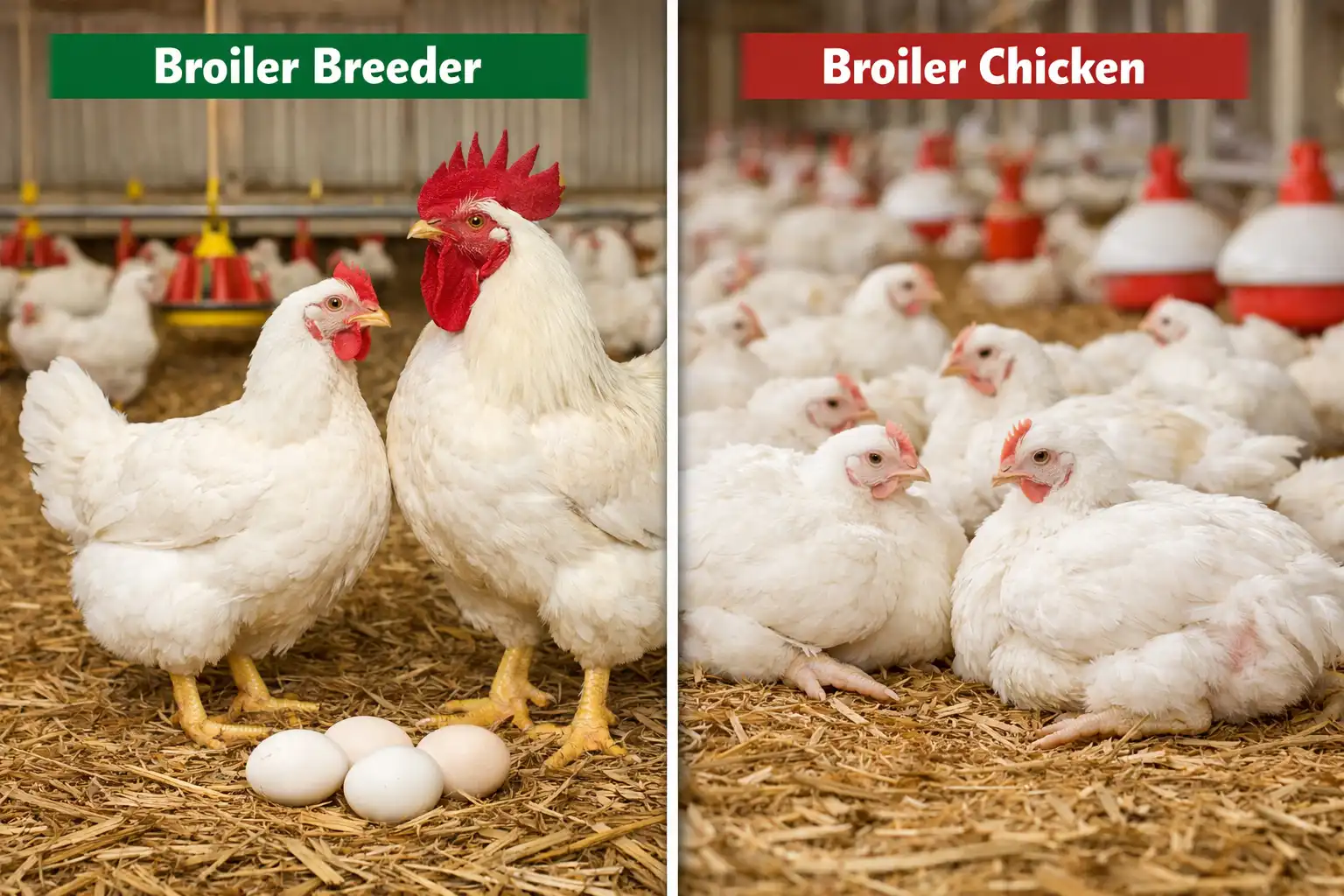
The chicken on your dinner plate didn’t just happen by chance. Behind every broiler chicken is a sophisticated breeding system involving specialized birds called broiler breeders. Understanding this system reveals the complexity of modern food production and raises important questions about genetics, nutrition, and animal welfare.
Broilers vs. Layers: Two Different Birds
Understanding the Fundamental Difference
Before diving into broiler breeding, it’s crucial to understand that the chickens we eat (broilers) are completely different from the chickens that produce the eggs we buy (layers). These are two separate genetic lines, bred for entirely different purposes.
Key Distinction
- Broiler chickens = Meat production (what you eat as chicken meat)
- Layer chickens = Egg production (produce eggs you buy at the store)
- Broiler breeders = Parent birds that produce eggs that hatch into broiler chickens (NOT the eggs you eat)
Why This Matters:
The eggs you buy at the grocery store come from layer hens and will NEVER hatch because:
- They are unfertilized - No roosters are kept with commercial laying hens
- Layer genetics - These chickens are bred for egg production, not meat
- Different purpose - Commercial egg production vs. hatching chicks
Let’s explore both types:
What Are Broiler Chickens?
The Meat Birds
Broiler chickens are birds specifically bred for meat production. Unlike laying hens (bred for egg production) or dual-purpose breeds, broilers are genetically engineered to:
- Grow extremely fast: Reach market weight (2-2.5 kg) in just 35-42 days
- Have high feed conversion efficiency: Convert feed into meat at ratios of 1.6-1.8:1
- Develop large breast muscles: The white meat consumers prefer
- Mature quickly: Ready for slaughter at just 5-7 weeks old
Why Are They So Different?
Modern broilers are the result of over 60 years of intensive genetic selection. Every generation, breeding companies select birds with:
- Faster growth rates
- Better feed conversion
- Larger muscle mass (especially breast meat)
- Disease resistance
- Improved meat quality
This selective breeding has created birds that are fundamentally different from their ancestors or wild counterparts.
What Are Layer Chickens (Egg-Laying Hens)?
The Egg Production Specialists
Layer chickens are completely different birds, bred specifically for egg production:
Key Characteristics:
- High egg production: 280-320 eggs per year
- Small body size: 1.5-2.0 kg at maturity
- Low feed consumption: Efficient conversion to eggs, not meat
- Long productive life: 72-80 weeks of egg laying
- No meat value: Very little muscle, mostly bone and organs
Major Differences from Broilers:
| Trait | Broiler Chickens | Layer Chickens |
|---|---|---|
| Purpose | Meat production | Egg production |
| Lifespan | 35-42 days | 18-24 months |
| Weight at maturity | 2.5 kg (5-6 weeks) | 1.8 kg (18 weeks) |
| Eggs laid | 0 (slaughtered young) | 280-320 per year |
| Feed efficiency | Convert to meat (1.6:1) | Convert to eggs |
| Breast muscle | Large, heavy | Small, minimal |
| Body type | Chunky, muscular | Lean, lightweight |
| Genetics | Cornish × White Rock crosses | Leghorn or Rhode Island crosses |
Why Store-Bought Eggs Don’t Hatch
The Simple Answer: They’re Unfertilized
When you buy eggs at the supermarket:
- No roosters present: Commercial layer farms keep ONLY hens
- Unfertilized eggs: Without a rooster, eggs cannot be fertilized
- No embryo development: These eggs will never become chicks, no matter how long you incubate them
- Economic efficiency: Roosters eat feed but don’t lay eggs, so they’re not kept
How Do Hens Lay Eggs Without a Rooster?
The Biology of Egg Production:
Many people are surprised to learn that hens lay eggs whether or not a rooster is present. Here’s how:
The Egg Formation Process (24-26 hours):
-
Ovulation (Hour 0):
- Hen’s ovary releases a yolk (ovum)
- This happens naturally every 24-26 hours in laying hens
- No rooster needed for this process
-
Fertilization Window (0-30 minutes):
- If a rooster has mated with the hen in the past 2 weeks
- Sperm stored in hen’s body can fertilize the yolk here
- This is the ONLY step where a rooster is involved
- Without a rooster: yolk proceeds unfertilized
-
Albumen Formation (Hours 3-4):
- Yolk moves through oviduct
- Egg white (albumen) layers form around yolk
- Chalazae (twisted strands) develop to hold yolk centered
-
Shell Membrane Formation (Hour 5):
- Two protective membranes form around albumen
-
Shell Formation (Hours 5-20):
- Calcium carbonate deposited to form hard shell
- Takes about 20 hours (longest part of process)
- Shell gland adds pigment (if brown egg)
-
Bloom/Cuticle (Hour 24):
- Final protective coating applied
- Seals pores in shell
-
Laying (Hour 24-26):
- Hen lays the complete egg
- Process immediately starts again with next yolk
Key Point:
Out of this entire 24-26 hour process, fertilization only happens in the first 30 minutes, and ONLY if a rooster was present. All the other steps—which is 99% of egg formation—happen exactly the same whether or not there’s a rooster.
Hormonal Trigger:
Egg laying is triggered by:
- Light exposure: 14-16 hours of light per day
- Hormones: Luteinizing hormone (LH) causes ovulation
- Genetics: Modern layers bred to lay almost daily
- Age: Peak production at 25-35 weeks of age
None of these require a rooster!
What About “Fertile” Eggs?
Some specialty stores sell fertilized eggs from farms that keep roosters:
- These CAN hatch if incubated properly
- Usually from small farms or backyard flocks
- More expensive than regular eggs
- Marketed as “fertilized” or from “mixed flocks”
Can You Tell the Difference?
Without special equipment, no! Both look identical:
- Blood spot: Does NOT mean fertilized (broken blood vessel)
- White spot (chalaza): Normal, not an embryo
- Ring on yolk: Only visible after several days of incubation in fertilized eggs
How Layer Breeds Are Created
If commercial eggs don’t hatch, how do layer farms get new chickens? The answer: Layer Breeders - a separate breeding system parallel to broiler breeders.
The Layer Breeding Pyramid:
graph TB
    A[Layer Great-Grandparent Stock
Pure Lines for Egg Production] --> B[Layer Grandparent Stock
Crosses]
    B --> C[Layer Parent Stock - Layer Breeders
WITH Roosters]
    C --> D[Commercial Layer Hens
Egg Production - NO Roosters]

    style A fill:#006400,color:#fff
    style B fill:#228B22,color:#fff
    style C fill:#32CD32,color:#000
    style D fill:#90EE90,color:#000
Layer Breeding System:
Level 1: Great-Grandparent Layer Stock
- Pure lines selected for egg production traits
- Companies: Hy-Line, Lohmann, Bovans, ISA
- Traits selected:
- Egg numbers (280-320 eggs/year)
- Egg size (60-65 grams)
- Shell quality (strong, no cracks)
- Feed efficiency (converts feed to eggs)
- Livability (low mortality)
- Egg color (white or brown, depending on market)
Level 2: Grandparent Layer Stock
- Crosses between pure lines
- Produce the parent stock
- Hybrid vigor for productivity
Level 3: Parent Stock (Layer Breeders)
- Key difference: These flocks HAVE roosters (ratio 1:10)
- Males and females housed together
- Eggs are FERTILIZED and sent to hatcheries
- These eggs hatch into commercial layer chicks
Level 4: Commercial Layer Hens
- NO roosters - females only
- Produce unfertilized table eggs
- These eggs go to grocery stores
- Will NEVER hatch
Critical Point
Layer breeders (with roosters) produce fertilized eggs → hatch into layer chicks → raised to 18 weeks → become commercial layers (without roosters) → produce unfertilized eggs for human consumption.
Mating Systems: Broilers vs. Layers
Understanding the Critical Difference:
Broiler Breeding System:
✅ Natural mating ALWAYS happens
- Broiler breeder flocks have roosters (males) with hens (females)
- Ratio: 1 rooster per 8-10 hens
- Males and females housed together 24/7
- Natural mating occurs continuously
- Result: Nearly all eggs are FERTILIZED (85-95%)
- Purpose: These fertilized eggs hatch into broiler chickens for meat production
- Eggs never sold for consumption - all sent to hatcheries
Layer Breeding System - Two Separate Stages:
Stage 1: Layer Breeder Flocks (For Regeneration Only)
✅ Natural mating happens here (Only at this level)
- Layer breeder flocks have roosters with hens
- Ratio: 1 rooster per 10-12 hens
- Natural mating occurs
- Result: Fertilized eggs (90-95%)
- Purpose: These eggs hatch into the next generation of layer chickens
- This is ONLY for creating new layer birds - not for table eggs
Stage 2: Commercial Layer Flocks (For Egg Production)
❌ NO mating happens
- Commercial layer farms have ZERO roosters
- 100% female birds only
- No mating possible
- Result: All eggs are UNFERTILIZED (100%)
- Purpose: These eggs sold as table eggs in stores
- Will NEVER hatch - meant for human consumption
Summary Table:
| Type | Roosters Present? | Mating? | Eggs Fertilized? | Egg Purpose |
|---|---|---|---|---|
| Broiler Breeders | ✅ Yes (always) | ✅ Yes | ✅ Yes (85-95%) | Hatch into broilers for meat |
| Layer Breeders | ✅ Yes (only this level) | ✅ Yes | ✅ Yes (90-95%) | Hatch into layer chickens |
| Commercial Layers | ❌ No | ❌ No | ❌ No (0%) | Sold as table eggs for eating |
| Broiler Chickens | N/A | N/A | N/A | Slaughtered at 35-42 days for meat |
Layer Breeding Selection:
Modern layer genetics focus on:
-
Egg Production:
- Peak production: 95-98% (almost every hen lays daily)
- Total eggs: 320-350 over 80 weeks
- Persistency: Maintain high production longer
-
Egg Quality:
- Shell strength (prevent cracks during handling)
- Shell color uniformity (white or brown)
- Yolk color (consumer preference)
- Albumen (egg white) height and quality
-
Feed Efficiency:
- Feed per dozen eggs produced
- Body weight maintenance
- Lower feed costs
-
Health and Welfare:
- Disease resistance
- Skeletal strength (calcium demands)
- Reduced feather pecking
- Calm temperament
-
Livability:
- Low mortality rates
- Adaptability to different housing systems
- Heat tolerance
Major Layer Genetics Companies:
- Hy-Line International (USA) - Hy-Line Brown, W-36 White
- Lohmann Tierzucht (Germany) - LSL, LB
- Hendrix Genetics (Netherlands) - Bovans, ISA
- Novogen (France) - Brown and white lines
White Eggs vs. Brown Eggs:
Different layer breeds produce different egg colors:
-
White eggs: White Leghorn breeds (most efficient)
- Lighter body weight
- Lower feed consumption
- Popular in USA, Asia
-
Brown eggs: Rhode Island Red crosses
- Slightly heavier birds
- Higher feed needs
- Premium pricing in some markets
- Popular in Europe, India
Male Chicks in Layer Production
The Controversial Reality:
When layer breeder eggs hatch:
- 50% are females (will become layers)
- 50% are males (cannot lay eggs, poor meat quality)
What Happens to Male Layer Chicks?
This is one of the most controversial aspects:
-
Culled at hatchery (most common)
- Males are euthanized on day 1
- Cannot lay eggs (useless for egg production)
- Wrong genetics for meat production (too lean)
- Billions annually worldwide
-
New Technology - In-Ovo Sexing:
- Determine sex before hatching
- Prevent development of male embryos
- Companies: Orbem, Seleggt
- Being adopted in Europe
-
Dual-Purpose Breeds (alternative)
- Heritage breeds good for both eggs AND meat
- Much less productive than specialized breeds
- Growing niche market
What Are Broiler Breeders?
The Parent Stock
Broiler breeders are the parent birds that produce the eggs which hatch into broiler chickens. They are essentially the same genetic stock as broilers, but they are:
- Raised to sexual maturity (around 22-24 weeks)
- Maintained for reproduction rather than slaughtered for meat
- Fed controlled diets to prevent excessive weight gain
- Kept for 40-65 weeks to produce fertilized eggs
Key Distinction
Broiler breeders are not a different breed—they are the same genetic line as broiler chickens, just raised and managed differently for reproduction rather than meat production.
The Breeding Pyramid
The poultry industry operates on a genetic pyramid structure:
graph TB
    A[Great-Grandparent Stock
Pure Lines] --> B[Grandparent Stock
Crosses]
    B --> C[Parent Stock - Broiler Breeders
Commercial Production]
    C --> D[Broiler Chickens
Meat Production]

    style A fill:#8B0000,color:#fff
    style B fill:#DC143C,color:#fff
    style C fill:#FF6347,color:#fff
    style D fill:#FFA07A,color:#000
Level 1: Great-Grandparent Stock (GGP)
- Pure genetic lines maintained by breeding companies (like Cobb, Ross, Aviagen)
- Extremely valuable and heavily protected
- Small population (thousands worldwide)
- Source of all genetic improvements
Level 2: Grandparent Stock (GP)
- Crosses between pure lines
- Produce parent stock
- Medium-sized operations
Level 3: Parent Stock (Broiler Breeders)
- The commercial broiler breeders
- Produce fertilized eggs for broiler production
- Large-scale operations (millions of birds)
Level 4: Broiler Chickens
- The end product for meat consumption
- Billions of birds annually worldwide
How Broiler Breeders Are Created
Genetic Selection Process
Creating broiler breeders involves sophisticated genetic programs:
1. Pure Line Development (Great-Grandparent Level)
Breeding companies maintain separate pure lines with specific traits:
- Line A: Exceptional growth rate and feed efficiency
- Line B: Superior breast meat yield and conformation
- Line C: Disease resistance and survivability
- Line D: Egg production and hatchability
Scientists measure thousands of traits including:
- Daily weight gain
- Feed conversion ratio
- Breast meat percentage
- Leg strength
- Immune response
- Egg production capacity
2. Crossbreeding (Grandparent Level)
Selected pure lines are crossed to create hybrid vigor (heterosis):
Line A (Male) × Line B (Female) = Grandparent Male LineLine C (Male) × Line D (Female) = Grandparent Female LineThese crosses combine desirable traits while maintaining genetic diversity.
3. Commercial Crosses (Parent/Breeder Level)
The grandparent lines are crossed to produce the broiler breeders:
GP Male × GP Female = Broiler Breeder (Parent Stock)These birds carry the genetic potential for:
- Rapid growth (when fed ad libitum)
- Efficient meat production
- Good egg production (for breeding purposes)
Modern Breeding Technologies
Today’s breeding companies use advanced technologies:
- Genomic Selection: DNA markers identify desirable genes without waiting for traits to express
- Artificial Insemination: Ensures genetic diversity and optimal crosses
- CT Scanning: Measures internal composition without slaughtering birds
- Big Data Analytics: Processes millions of data points for breeding decisions
- Family Breeding: Tracks pedigrees to optimize genetic gains
How Broiler Breeder Eggs Are Produced
The Breeder Flock Management
Managing broiler breeders is a delicate balance:
Growing Period (0-22 weeks)
The Feed Restriction Challenge:
Broiler breeders have the same genetic potential for rapid growth as broiler chickens. If allowed to eat freely:
- They would become obese by 10-12 weeks
- Reproductive organs wouldn’t develop properly
- They couldn’t mate naturally
- Egg production would be poor or zero
Therefore, feed restriction is mandatory:
- Feed allocation: 30-40% of what they would eat freely
- Daily weighing: Ensures target body weight curves
- Specialized diets: Lower energy, higher fiber
- Controlled lighting: Delays sexual maturity
Production Period (22-65 weeks)
Once sexually mature:
Housing:
- Males and females housed together (ratio 1:8 to 1:10)
- Nest boxes for egg laying
- Perches and enrichment (increasingly common)
Feeding:
- Gradually increased feed to support egg production
- Still controlled to prevent obesity
- Separate feeding programs for males and females
Egg Collection:
- Eggs collected 4-6 times daily
- Immediately fumigated and cooled
- Stored at 65-68°F (18-20°C) with 75% humidity
- Held for maximum 7 days before incubation
Fertilization and Egg Production
Natural Mating:
- Roosters (males) mate with hens (females)
- One mating can fertilize eggs for up to 2 weeks
- Fertilization rates: 85-95% in well-managed flocks
Artificial Insemination (AI):
- Increasingly used for heavy breeds
- Better fertility rates (95-98%)
- Requires less males (1:20 ratio)
- Labor intensive but more efficient
Egg Production:
- A breeder hen produces 150-180 hatching eggs in her lifetime
- Peak production: 85-90% (weeks 30-40)
- Each hatching egg produces one broiler chicken
- From one breeder hen: 150-180 broiler chickens produced
From Egg to Broiler: The Incubation Process
The Hatchery
Fertilized eggs go through a precise incubation process:
Stage 1: Setting (Days 0-18)
- Temperature: 99.5-100°F (37.5-37.8°C)
- Humidity: 50-60%
- Turning: Every hour (prevents embryo adhesion)
- CO₂ monitoring: Critical for development
Stage 2: Hatching (Days 18-21)
- Eggs transferred to hatching baskets
- Temperature: 98.5-99°F (36.9-37.2°C)
- Humidity: 65-70% (higher for shell penetration)
- No turning (chicks need to position themselves)
Day 21: Hatch Day
- Chicks pip (break shell) and emerge
- Hatchability: 85-90% of fertile eggs
- Quality control: Remove weak or deformed chicks
First Day Processing
Newly hatched chicks undergo:
- Sexing: Separating males and females (if needed)
- Vaccination: Against Marek’s disease, Newcastle disease, etc.
- Quality grading: Only vigorous chicks are shipped
- Transportation: To broiler farms within 24-48 hours
How Fast-Growing Breeds Are Created
The Science of Genetic Selection
Historical Progress:
| Year | Days to 2kg | Feed Conversion | Breast Yield |
|---|---|---|---|
| 1957 | 84 days | 3.0:1 | 15% |
| 1977 | 56 days | 2.3:1 | 18% |
| 1997 | 42 days | 1.9:1 | 21% |
| 2017 | 35 days | 1.6:1 | 24% |
| 2025 | 33 days | 1.5:1 | 26% |
Key Selection Criteria:
1. Growth Rate:
- Selection for genes controlling muscle development
- Focus on IGF-1 (Insulin-like Growth Factor) pathways
- Target: Maximum weight gain per day
2. Feed Efficiency:
- Measure feed consumed vs. weight gained
- Select birds with best conversion ratios
- Economic driver: Feed is 60-70% of production costs
3. Breast Meat Yield:
- Consumer preference for white meat
- Genetic markers for pectoralis muscle development
- Some lines now 26-28% breast meat
4. Leg Health:
- Balance rapid growth with skeletal strength
- Selection for bone density and leg conformation
- Reduce lameness issues
5. Survivability:
- Disease resistance through genetic markers
- Cardiovascular health (rapid growth stresses heart)
- Overall vitality and vigor
The Trade-offs
Extreme selection for growth has created challenges:
Metabolic Issues:
- Heart and lung capacity struggle to keep up
- Ascites (fluid in abdomen) from heart failure
- Sudden death syndrome
Skeletal Problems:
- Leg weakness and lameness (3-5% of birds)
- Rapid muscle growth outpaces bone development
- Joint problems and difficulty walking
Reproductive Challenges:
- Broiler breeders must be feed-restricted
- Natural mating becomes difficult with heavy birds
- Welfare concerns about chronic hunger
Industry Response
Modern breeding programs now include:
- Welfare traits in selection indexes
- Balanced breeding for growth AND health
- Development of slower-growing alternatives
- Investment in animal welfare research
Nutrition: Feeding Broilers vs. Breeders
Broiler Chicken Nutrition
Broilers are fed to maximize growth:
Starter Diet (0-10 days):
- Crude Protein: 23-24%
- Energy: 3,000-3,100 kcal/kg
- High in amino acids (lysine, methionine)
- Easily digestible ingredients
- Medicated (coccidiostat)
Grower Diet (11-24 days):
- Crude Protein: 21-22%
- Energy: 3,100-3,200 kcal/kg
- Balanced amino acid profile
- Added enzymes for digestion
Finisher Diet (25-42 days):
- Crude Protein: 19-20%
- Energy: 3,200-3,300 kcal/kg
- Focus on fat deposition and meat quality
- Withdrawal of medications (before slaughter)
Key Ingredients:
- Corn/maize (energy source)
- Soybean meal (protein source)
- Fish meal or meat and bone meal (protein)
- Vitamins and minerals
- Synthetic amino acids (lysine, methionine)
- Enzymes (phytase, protease, xylanase)
Feed Consumption:
- Total feed consumed: 3.2-3.8 kg per bird
- Final body weight: 2.0-2.5 kg
- Feed conversion ratio: 1.5-1.7:1
Broiler Breeder Nutrition
Breeders require specialized nutrition:
Growing Period (0-22 weeks):
- Restricted feeding: 30-40% of ad libitum intake
- Lower energy density: 2,700-2,800 kcal/kg
- Higher fiber: 5-7% (provides satiety)
- Moderate protein: 15-17%
- Focus: Controlled growth to target body weight
Production Period (22-65 weeks):
- Increased feed: Supports egg production
- Energy: 2,800-2,900 kcal/kg
- Protein: 16-18%
- High calcium: 3.5-4.0% (for egg shells)
- Phosphorus: 0.4-0.5%
- Vitamins: Especially D₃, E, biotin
- Omega-3 fatty acids: Improved hatchability
Male Nutrition:
- Separate feeding programs
- Lower energy than females
- Maintain body condition without obesity
- Support sperm production and viability
Health and Welfare Considerations
Broiler Chicken Health
Common Health Issues:
-
Respiratory Diseases:
- Newcastle disease
- Infectious bronchitis
- Aspergillosis
- Prevention: Vaccination, ventilation
-
Digestive Disorders:
- Coccidiosis (parasitic)
- Necrotic enteritis
- Prevention: Anticoccidials, probiotics
-
Metabolic Problems:
- Ascites (fluid in body cavity)
- Sudden death syndrome
- Cause: Rapid growth, heart/lung stress
-
Leg Disorders:
- Tibial dyschondroplasia
- Bacterial chondronecrosis
- Lameness
- Prevention: Nutrition, lighting, genetics
Welfare Improvements:
- Slower growing genetics: 48-56 day birds
- Lower stocking density: More space per bird
- Environmental enrichment: Perches, pecking objects
- Natural lighting: Windows in barns
- Outdoor access: Free-range and organic systems
Broiler Breeder Health
Unique Challenges:
-
Feed Restriction Stress:
- Chronic hunger
- Stereotypic behaviors (pecking, pacing)
- Solutions: Higher fiber, scatter feeding, enrichment
-
Obesity Prevention:
- Essential for reproduction
- Requires constant monitoring
- Balance between welfare and productivity
-
Reproductive Issues:
- Egg peritonitis (egg material in body cavity)
- Prolapse (oviduct protrusion)
- Male infertility from excessive weight
-
Foot Pad Dermatitis:
- From poor litter quality
- Leads to lameness and infection
- Prevention: Litter management, lower density
Welfare Enhancements:
- Qualitative feed restriction: Lower energy density vs. quantitative
- Scatter feeding: Encourages foraging behavior
- Environmental enrichment: Reduces stress behaviors
- Breeding for welfare: Selection includes welfare traits
What Happens to Broiler Breeders After Laying?
The End of Production
Broiler Breeder Lifecycle:
- Production period: 22-65 weeks (about 40-43 weeks of egg laying)
- Total eggs produced: 150-180 hatching eggs per hen
- After 65 weeks: Egg production declines significantly
- Fertility drops: Hatchability decreases
- Decision point: No longer economically viable
What Happens Next: Culling and Processing
✅ Yes, broiler breeders are eaten after their laying period ends
Unlike layer hens (which have minimal meat value), broiler breeders have substantial meat because they share the same genetics as broiler chickens.
Broiler Breeder Meat Characteristics
Why They’re So Heavy:
You’re correct in observing 4-5 kg weights! Here’s why:
Female Broiler Breeders:
- Target body weight: 3.2-3.8 kg (during production)
- After 60+ weeks: 3.5-4.5 kg
- Heavy for a hen: Because they have broiler genetics (rapid growth genes)
- Feed restriction prevented obesity: Without restriction, they’d be even heavier
Male Broiler Breeders (Roosters):
- Target body weight: 4.5-5.5 kg (during production)
- After 60+ weeks: 5.0-6.5 kg
- Very large birds: Massive compared to layer males
- Also feed restricted: Would be 7-8 kg without restriction
Comparison:
| Bird Type | Weight at Culling | Meat Value |
|---|---|---|
| Commercial broiler | 2.5 kg (42 days) | High - primary product |
| Broiler breeder female | 3.5-4.5 kg (65 weeks) | High - substantial meat |
| Broiler breeder male | 5.0-6.5 kg (65 weeks) | Very high - large bird |
| Layer hen | 1.5-2.0 kg (90 weeks) | Very low - mostly bone |
| Layer rooster | 2.0-2.5 kg (65 weeks) | Low - lean, tough |
Market for Spent Broiler Breeders
Commercial Uses:
-
Processed Chicken Products:
- Mechanically separated chicken (MSC)
- Chicken sausages
- Chicken nuggets and patties
- Canned chicken
- Chicken soup bases
- Pet food (high-quality protein)
-
Food Service Industry:
- Restaurant chains (curries, stews)
- Institutions (hospitals, schools)
- Catering companies
- Any application requiring cooked, processed chicken
-
Retail Markets (Some Regions):
- India: Sold as “country chicken” or “desi murgi” (higher price than broiler)
- Africa: Sold as mature chicken for soups
- Asia: Popular for traditional dishes requiring older birds
- Marketed as free-range or farm chicken
-
Export Markets:
- Leg quarters to Africa
- Dark meat to Asian markets
- Processed products globally
Meat Quality Differences:
Broiler Breeder Meat vs. Young Broiler Meat:
| Characteristic | Young Broiler (42 days) | Broiler Breeder (65 weeks) |
|---|---|---|
| Texture | Very tender, soft | Firmer, tougher (older bird) |
| Flavor | Mild, neutral | More pronounced, “chickeny” |
| Fat content | Moderate | Lower (feed restricted) |
| Muscle development | Tender, underdeveloped | Mature, well-developed |
| Cooking method | Grill, fry, roast | Stew, curry, slow cook |
| Breast meat | Large, very tender | Large but tougher |
| Dark meat | Tender | Flavorful but chewy |
| Price | Standard (₹120-180/kg) | Lower (₹80-120/kg) or Higher (if sold as “country” ₹250-350/kg) |
Why the Texture Difference?
- Age: 65 weeks vs. 42 days = much older bird
- Exercise: Breeders moved around more = developed muscles
- Collagen: Older birds have more connective tissue
- Muscle fiber: Longer life = tougher muscle fibers
Cooking Recommendations:
- Best methods: Slow cooking, pressure cooking, stewing, curries
- Avoid: Quick grilling or frying (will be tough)
- Soups: Excellent for rich, flavorful chicken stock
- Traditional dishes: Perfect for recipes calling for older chickens
Economic Value
Why Farmers Sell Spent Breeders:
Revenue from one broiler breeder hen:
- Hatching eggs: 150-180 eggs × ₹8-12/egg = ₹1,200-2,160
- Meat value at culling: 3.5-4.5 kg × ₹80-120/kg = ₹280-540
- Total value: ₹1,480-2,700 over lifetime
Why they have meat value:
- Same genetics as broilers (growth genes)
- Substantial body weight (4-5 kg as you observed)
- Much better meat quality than layer hens
- Processors want them for specific products
Spent Layer Hens (For Comparison):
Layer hens also get culled, but their meat value is much lower:
- Weight: 1.5-2.0 kg only
- Very little breast meat
- Extremely tough (90+ weeks old)
- Mostly used for: Soups, pet food, rendering
- Price: ₹30-60/kg (very low)
Identification in Markets
How to Recognize Broiler Breeder Meat:
If you’re buying chicken and notice:
- Large size: 3.5-5+ kg whole bird
- Firm texture: Not as soft as young broiler
- Yellow skin: Often has more yellow pigmentation
- Larger bones: Thick, mature skeletal structure
- Lower price: Cheaper than young broiler OR
- “Country chicken” label: Higher price, marketed as traditional
Likely it’s a spent broiler breeder or similar older bird.
In India:
- Often sold as “desi murgi” (country chicken) even though it’s not truly indigenous
- Preferred for curries, biryanis, and traditional dishes
- Consumers appreciate stronger flavor
- Price varies: Sometimes cheaper (as spent breeder), sometimes premium (as “country”)
Global Production and Economics
Industry Scale
Global Broiler Production (2025):
- Total birds: ~70 billion annually
- Meat production: 100+ million tons
- Top producers: USA, China, Brazil, EU
- Fastest growing: Southeast Asia, Africa
Broiler Breeder Operations:
- Global flock: ~700 million breeders
- Each hen produces: 150-180 chicks/lifetime
- Ratio: 1 breeder produces ~100 kg of broiler meat annually
Economic Factors
Cost Structure:
- Feed: 60-70% of total cost
- Chicks: 15-20%
- Labor, utilities, medicine: 10-15%
- Housing and equipment: Amortized over years
Why Broilers Dominate:
- Efficiency: Best feed conversion of all livestock
- Speed: 35-42 days production cycle
- Cost: Cheapest protein source ($/kg)
- Versatility: Whole birds, parts, processed products
- Cultural acceptance: Widely eaten globally
The Future of Broiler Production
Emerging Trends
1. Welfare-Focused Genetics:
- Development of robust, slower-growing lines
- Selection for leg health, heart health
- Companies like Hubbard JA57, Aviagen Rowan Ranger
2. Precision Farming:
- AI and sensors monitor individual bird health
- Automated feeding and climate control
- Early disease detection through behavior analysis
3. Antibiotic Reduction:
- No-antibiotic-ever (NAE) production
- Probiotics, prebiotics, organic acids
- Vaccination improvements
4. Sustainability:
- Lower carbon footprint genetics
- Waste reduction and recycling
- Alternative protein feeds (insects, algae)
5. Cell-Cultured Meat:
- Broiler cells grown in bioreactors
- No live birds needed
- Still early stage but advancing
Alternative Systems
Growing consumer demand for:
Free-Range:
- Outdoor access during daytime
- Lower stocking density
- Slower-growing breeds
Organic:
- Organic feed only
- No synthetic medications
- Outdoor access required
- Much slower growth (70-81 days)
Pasture-Raised:
- Mobile coops on grass
- Rotational grazing
- Very low density
- Premium prices
Animal Welfare Certified:
- Third-party audited standards
- Better living conditions
- Higher welfare outcomes
Popular Chicken Breeds Around the World
Beyond commercial broilers and layers, there’s a fascinating diversity of chicken breeds, each with unique characteristics. From fast-growing commercial hybrids to ancient indigenous breeds, let’s explore the varieties you might encounter.
Commercial Breeds
1. Modern Broiler Hybrids (Meat Production)
These are not true “breeds” but genetic crosses:
Cobb 500 (Most popular worldwide)
- Origin: USA (Cobb-Vantress)
- Market weight: 2.5 kg at 35-38 days
- Feed conversion: 1.5-1.6:1
- Breast yield: 26-28%
- Global market share: ~30%
- Best for: Intensive commercial production
Ross 308 (Second most popular)
- Origin: UK/USA (Aviagen)
- Market weight: 2.5 kg at 35-40 days
- Feed conversion: 1.55-1.65:1
- Excellent leg health
- Global market share: ~25%
- Best for: Whole bird and parts production
Hubbard Classic
- Origin: France
- Slower growing: 42-49 days
- More robust, better welfare
- Popular in Europe for free-range
- Yellow skin (European preference)
2. Layer Breeds (Egg Production)
White Leghorn
- Origin: Italy (Livorno)
- Color: White feathers, white eggs
- Egg production: 280-320 eggs/year
- Body weight: 1.5-1.8 kg
- Temperament: Active, flighty, nervous
- Feed efficiency: Excellent (lowest feed per egg)
- Most common: Hy-Line W-36, Lohmann LSL
- Best for: Commercial white egg production
Rhode Island Red Crosses (Brown egg layers)
- Origin: USA (Rhode Island)
- Color: Reddish-brown feathers, brown eggs
- Egg production: 250-290 eggs/year
- Body weight: 2.0-2.5 kg
- Temperament: Calmer than Leghorns
- Common hybrids: Hy-Line Brown, Lohmann Brown
- Best for: Commercial brown egg production, backyard flocks
Indigenous Indian Breeds
India has a rich heritage of native chicken breeds, developed over centuries for local conditions:
1. Kadaknath (Kali Masi - Black Meat Fowl)
Perhaps the most unique chicken breed in India:
- Origin: Jhabua district, Madhya Pradesh
- Unique feature: Black flesh, black bones, black organs (due to melanin)
- Color: Black feathers with greenish sheen
- Size: 1.5-2.0 kg at maturity
- Egg production: 80-100 eggs/year (low)
- Growth: Very slow (120-150 days to maturity)
- Meat quality:
- High protein content (25-27% vs. 18% in broilers)
- Low fat content (0.73-1.03%)
- Rich in amino acids
- Believed to have medicinal properties
- Price: Premium (₹800-1200/kg vs. ₹150-200 for broiler)
- Status: Geographical Indication (GI) tag
- Best for: Gourmet market, traditional medicine (Ayurveda)
2. Aseel (Asil)
Ancient Indian fighting breed:
- Origin: Rajasthan, Punjab, Andhra Pradesh
- Purpose: Originally for cockfighting, now for meat
- Characteristics:
- Muscular, broad-chested, aggressive
- Compact, upright posture
- Strong legs and beak
- Varieties: Peela (golden), Yakub (black), Reza (white)
- Size: 3-5 kg (males), 2-3 kg (females) - one of the largest
- Egg production: 40-60 eggs/year (very low)
- Growth: Extremely slow (180-240 days)
- Meat: Very firm, muscular, gamy flavor
- Temperament: Highly aggressive, territorial
- Price: High (₹500-800/kg)
- Best for: Backyard breeding, specialty meat market
3. Giriraja (Gramapriya)
Semi-intensive Indian crossbreed:
- Origin: ICAR-Directorate of Poultry Research, Hyderabad
- Type: Crossbreed (improved dual-purpose)
- Development: Cross between local breeds and commercial stock
- Characteristics:
- Color: Multicolored (brown, black, white patterns)
- Hardy, disease-resistant
- Adaptable to free-range
- Size: 1.5-2.0 kg at 70-75 days
- Egg production: 180-200 eggs/year (good for backyard)
- Growth: Moderate (faster than pure indigenous, slower than broilers)
- Purpose: Dual-purpose (eggs and meat)
- Price: Moderate (₹250-350/kg)
- Best for: Rural backyard poultry, small farmers
- Advantages:
- Can survive on kitchen scraps and foraging
- Better disease resistance than commercial breeds
- Lower input costs
- Suitable for organic farming
4. Tamil Nadu Native Breeds
Tamil Nadu has several unique indigenous varieties:
Siruvidai Kozhi (Small-bodied chicken)
- Name meaning: “Siru” = small, “Vidai” = category/type
- Size: 0.8-1.2 kg (smallest indigenous variety)
- Color: Varied (black, brown, white, mixed)
- Egg production: 60-80 eggs/year
- Characteristics:
- Extremely hardy
- Good foragers
- Minimal feed requirements
- Excellent mothering instinct
- Growth: 150-180 days to maturity
- Best for: Backyard poultry, poor rural households
- Advantages: Survives on minimal inputs
Peruvidai Kozhi (Large-bodied chicken)
- Name meaning: “Peru” = big/large, “Vidai” = category/type
- Size: 2.0-3.0 kg (largest Tamil Nadu variety)
- Color: Varied, often multicolored
- Egg production: 70-90 eggs/year
- Characteristics:
- Larger frame, heavier
- Good meat quality
- Better egg size
- Hardy and disease-resistant
- Growth: 180-210 days to maturity
- Best for: Meat production in backyard systems
- Price: ₹300-400/kg
Kili Mookku Kozhi (Parrot-beaked chicken)
- Name meaning: “Kili” = parrot, “Mookku” = nose/beak
- Unique feature: Short, curved beak resembling a parrot
- Size: 1.5-2.0 kg
- Color: Usually black or dark brown
- Rarity: Very rare, endangered
- Characteristics:
- Distinctive short beak (genetic mutation)
- Compact body
- Good foragers despite beak shape
- Strong, active birds
- Status: Conservation efforts underway
- Best for: Genetic conservation, specialty breeding
Other Notable Indigenous Breeds
5. Chittagong (Bangladesh/Bengal)
- Origin: Chittagong, Bangladesh
- Size: One of the tallest (roosters up to 60 cm)
- Weight: 3-5 kg
- Egg production: 100-120 eggs/year
- Known for: Large size, good meat
6. Nicobari
- Origin: Nicobar Islands, India
- Unique: Only indigenous breed in Bay of Bengal islands
- Color: Multiple colors, iridescent black most prized
- Size: Medium (1.5-2.0 kg)
- Adaptation: Coastal climate, tsunami-resistant (survived 2004)
- Status: Rare, conservation priority
7. Naked Neck (Turken)
- Origin: Transylvania (found in India too)
- Unique feature: No feathers on neck (looks like turkey)
- Advantage: Heat tolerance (fewer feathers)
- Weight: 2-3 kg
- Popular in: Hot climates
Guinea Fowl - Not a Chicken!
Important Distinction: Guinea fowl are NOT chickens—they’re a different species entirely.
Guinea Fowl (Numida meleagris)
- Family: Numididae (chickens are Phasianidae)
- Origin: Africa (domesticated in ancient Egypt)
- Appearance:
- Gray/black feathers with white spots
- Bald, colorful head (blue, red)
- Hunchback posture
- No comb or wattle like chickens
- Size: 1.5-2.0 kg
- Egg production: 60-100 eggs/year (seasonal)
- Eggs: Smaller than chicken eggs, very hard shells
- Meat: Dark, gamy, lean (like game birds)
- Temperament: Wild, noisy, flighty
- Special traits:
- Excellent pest control (eat ticks, insects)
- Alert “watchdogs” (loud calls warn of predators)
- Roost in trees
- Terrible mothers (often abandon nests)
Differences from Chickens:
| Trait | Chickens | Guinea Fowl |
|---|---|---|
| Species | Gallus gallus domesticus | Numida meleagris |
| Domestication | 8,000+ years | 5,000+ years |
| Temperament | Calm (most breeds) | Wild, nervous |
| Noise level | Moderate | Very loud |
| Flying ability | Limited | Excellent |
| Purpose in India | Meat, eggs | Pest control, meat |
| Mothering | Good | Poor |
| Egg incubation | 21 days | 26-28 days |
Uses in India:
- Pest control in orchards and farms (eat insects, snakes)
- Specialty meat market (₹400-600/kg)
- Alarm birds (warn of predators, intruders)
- Organic farming systems
Comparison: Commercial vs. Indigenous Breeds
Why Broilers Dominate Commercial Production:
| Factor | Commercial Broilers | Indigenous Breeds |
|---|---|---|
| Days to 2 kg | 35-42 days | 120-210 days |
| Feed conversion | 1.5-1.7:1 | 3.5-5.0:1 |
| Breast meat % | 26-28% | 12-18% |
| Cost/kg | ₹120-180 | ₹250-1200 |
| Disease resistance | Low (need antibiotics) | High (hardy) |
| Feed requirements | Commercial feed only | Can forage |
| Survival rate | High (with management) | Very high |
| Meat texture | Tender, mild | Firm, gamy |
| Nutrition | Moderate protein | Higher protein |
| Suitability | Intensive farming | Free-range, backyard |
Why Indigenous Breeds Persist:
Despite slower growth:
- Hardiness: Survive harsh conditions, diseases
- Low inputs: Minimal commercial feed needed
- Free-range: Excellent foragers
- Flavor: Preferred taste for traditional dishes
- Cultural: Traditional recipes require native breeds
- Medicinal: Beliefs about health benefits (especially Kadaknath)
- Livelihood: Small farmers with limited resources
- Premium market: Urban demand for “country chicken”
- Organic farming: Fit organic/sustainable systems
- Genetic diversity: Conservation importance
Backyard Poultry Movement
There’s growing interest in indigenous breeds for:
- Food security: Self-sufficiency
- Nutrition: Higher protein, lower fat
- Sustainability: Lower environmental impact
- Culture: Preserving traditional breeds
- Income: Women’s empowerment through poultry
The Best Breed for You?
Choose based on your goal:
Commercial Farming (Large Scale):
- Broilers: Cobb 500, Ross 308
- Layers: Hy-Line, Lohmann
Backyard (Eggs + Meat):
- Giriraja/Gramapriya (best balance)
- Rhode Island Red
- Plymouth Rock
Organic/Free-Range:
- Indigenous breeds (Kadaknath, Aseel)
- Slower-growing broilers (Hubbard)
Premium Meat Market:
- Kadaknath (highest price)
- Aseel (gourmet/specialty)
- Country chicken
Minimal Input/Survival:
- Siruvidai Kozhi
- Any local indigenous variety
Pest Control:
- Guinea Fowl (technically not chicken)
Conservation/Hobby:
- Rare breeds (Kili Mookku, Nicobari)
- Heritage breeds
Summary: The Complete Picture
Three Separate Systems
To clarify the entire chicken production system:
1. Broiler System (Meat Production):
Broiler Breeders (with roosters) → Fertilized eggs → Hatch into broiler chicks → Raised 35-42 days → Slaughtered for MEAT2. Layer System (Egg Production):
Layer Breeders (with roosters) → Fertilized eggs → Hatch into layer chicks → Raised 18 weeks to maturity → Commercial layers (NO roosters) → Lay unfertilized eggs for 80 weeks → Eggs sold as TABLE EGGS (won't hatch)3. Breeding System (For Both):
Great-Grandparents (elite genetics) → Grandparents (crosses) → Parents/Breeders (with males) → Commercial production (meat or eggs)Key Points to Remember:
- Store eggs won’t hatch because they’re from layer hens kept without roosters (unfertilized)
- Broilers and layers are different breeds - one for meat, one for eggs
- Both systems have breeders - special flocks WITH roosters that produce fertilized eggs for hatching
- Commercial operations (broiler farms, layer farms) are the final step, producing meat or eggs for consumers
- Breeding companies maintain elite genetic lines separate from commercial production
Conclusion
The broiler breeding system is a marvel of modern agriculture—a complex genetic and management program that produces affordable protein for billions of people. From elite great-grandparent flocks to the breeder farms that produce billions of eggs, to the hatcheries and growout farms, every step is optimized for efficiency.
Similarly, the layer system operates in parallel, producing the billions of eggs consumed daily worldwide—eggs that will never hatch because they’re designed for food, not reproduction.
Yet this efficiency comes with challenges:
- Genetic extremes that compromise health
- Welfare concerns particularly for feed-restricted breeders
- Environmental impacts of large-scale production
- Antibiotic use and resistance concerns
The future likely holds:
- Balance between productivity and welfare
- Transparency in production methods
- Consumer choice among production systems
- Innovation in genetics, nutrition, and technology
Whether you choose conventional, free-range, organic, or alternative proteins, understanding where your food comes from—including the sophisticated breeding behind that chicken breast—empowers better decisions for your health, ethics, and the planet.